
Seminole County Address History Sources
A backward address trail has two tracks. Ownership comes from the Property Appraiser and recorded deeds. Occupancy comes from street directories, census schedules, newspapers, and related family records. The strongest account of previous residents keeps the tracks separate until names and dates overlap.
| Source | Years it covers | Where held | What it shows |
|---|---|---|---|
| Official Records | Portal defaults to 1983 to present; older records need Clerk help | Seminole County Clerk | Grantors, grantees, deeds, liens, plats, legal descriptions |
| Property roll | Current card with displayed sales | Property Appraiser | Current owner, situs, mailing address, deed bridge, building data |
| Sanford directories | Verified 1915–16 and 1917–18; cited years through 1975 | UCF, Sanford Museum, RICHES | Names and street entries; full-volume access varies |
| Federal census | Public schedules through 1950 | NARA and library genealogy tools | Enumerated household members |
| Permit inquiry | Portal start not stated | Seminole County Development Services | Construction and alteration chronology |
Start with the deed chain for recent ownership. Start with a street directory or census for an early household. When the target year falls between sources, use sales, permits, newspapers, probate, and obituaries to narrow the interval rather than guessing.
Start Seminole Previous Residents Today
The Seminole County Property Appraiser is the cleanest starting point for a modern address. Search by address, street, parcel number, owner, facility, or subdivision. Copy the current owner, situs, mailing address, parcel or APPR ID, legal description, subdivision and plat, sales references, building year, and GIS link. The situs is the assessed location. The mailing address may belong elsewhere.
A homestead exemption may support the idea that an owner used the property as a primary home, but it does not list every occupant. Likewise, an owner mailing address at the same site is useful evidence, not a household roster. The goal at this stage is to identify the exact land and its newest recorded transfer, not to name all previous residents.
Note: Free daily appraisal downloads can support a broad project, while a custom filtered request may take ten business days and incur labor fees.
Walk Seminole County Deeds Backward
Open the newest deed reference in the Official Records index. The buyer is the grantee and the seller is the grantor. Once the current purchase is confirmed by legal description, the seller becomes the next search subject. Look for that seller’s earlier purchase as grantee. Repeat this handoff to build the chain of title.
- Copy the current parcel ID, legal description, and sale reference from the appraisal card.
- Find the purchase deed and confirm the lot, block, plat, or full legal description.
- Record the grantor, grantee, instrument number, book and page, and filing date.
- Search the seller as an earlier grantee, testing name variants and date ranges.
- Repeat until the portal trail ends, then ask the Clerk about earlier books or images.
The portal supports Both, Grantee, or Grantor direction; last-name-first name entry; begin and end dates; recent filing periods; instrument type; book and page; file number; legal-description fragments; and consideration ranges. Results can be filtered and exported. This makes the deed chain far more reliable than matching owners by spelling alone.
- Grantor
- The person or entity transferring an interest in the recorded instrument.
- Grantee
- The person or entity receiving that interest.
- Chain of title
- The linked sequence of transfers for the same land.
- Legal description
- The recorded land description that remains useful when a street address changes.
Cross Seminole County’s 1983 Boundary
The Official Records portal currently opens with January 1, 1983 as its default begin date. The Clerk says all Official Records should now be online, but does not warrant a separate earliest complete image year. Treat the default as a practical search boundary, not proof that the land trail begins then. If a result or image is missing, search by book and page, instrument number, legal-description fragment, and spelling variants before asking the Clerk for help.
Florida law requires an online Official Records index at least through January 1, 1990. Older research can require deed books, counter help, or a public-records request. Images from current results may be viewed and printed without certification. Published copy charges are $1 per letter or legal page, $2 per instrument for certification, and $5 for e-certification, with a 5 percent card fee. A plain research copy is often enough for house history.
Portal myth. A statement that records should be online does not guarantee that every old image or index entry is complete.
Keep Seminole Addresses Through Renames
Street names can break a backward search even when the parcel never moved. The county’s official name-change list bridges the old and new labels with approval dates, jurisdictions, and resolutions. Examples include Onora Road to Airport Boulevard in 1972, Mohawk Road to Celery Avenue in 1978, Oviedo Marketplace Boulevard to Oviedo Mall Boulevard in 2011, and 13th Street West to Historic Goldsboro Boulevard in 2012.
Search each version of the street name in directories, newspapers, deeds, and permits. Use the legal description to prove continuity. Pre-1984 street resolutions were unnumbered and received internal file numbers, so search by date or other recorded reference when no modern resolution number appears. Mailing city and incorporated jurisdiction can also differ, especially across Seminole County’s cities and unincorporated communities.
Pair Seminole Directories With Census
Deeds trace owners, while directories and census schedules can expose past residents who did not own the land. The 1917–18 R.L. Polk Sanford volume contains a street section beginning on page 23, an alphabetical section and abbreviation key beginning on page 43, and coverage of ten communities. Search the address in the street section, then find each listed name in the alphabetical pages. Absence is not proof of absence because women, boarders, rural residents, and people who declined a listing may be missed.
Move from a nearby directory year to a public census year. Pair 1917–18 with the 1920 census, 1947 with 1940 or 1950, and 1952 with 1950. Census schedules are public through 1950 under the 72-year rule. The directory supplies a street and a short name; the census can supply a household, age, relationship, birthplace, and other context. Compare facts rather than assuming that two people with the same name are one person.
- Locate the address in the closest available street directory.
- Decode initials and abbreviations in that volume’s own key.
- Search the next public census using the name, community, and nearby households.
- Compare the census address or enumeration area with the directory street.
- Return to deeds, probate, and obituaries to resolve conflicts.
The directory collections themselves, their publishers, and their reading conventions are covered on the Seminole County city directory page.
Seminole Previous Residents in RICHES
The Sanford Avenue Collection cites directory source years including 1911, 1917–18, 1924, 1926, 1947, 1952, 1965, and 1975, though full-volume access varies. It can help place an address within a changing neighborhood and point toward the right directory year. The source is especially useful after the deed chain supplies a surname or an old street label.
View the RICHES Sanford Avenue Collection before using its neighborhood items as context for previous residents.
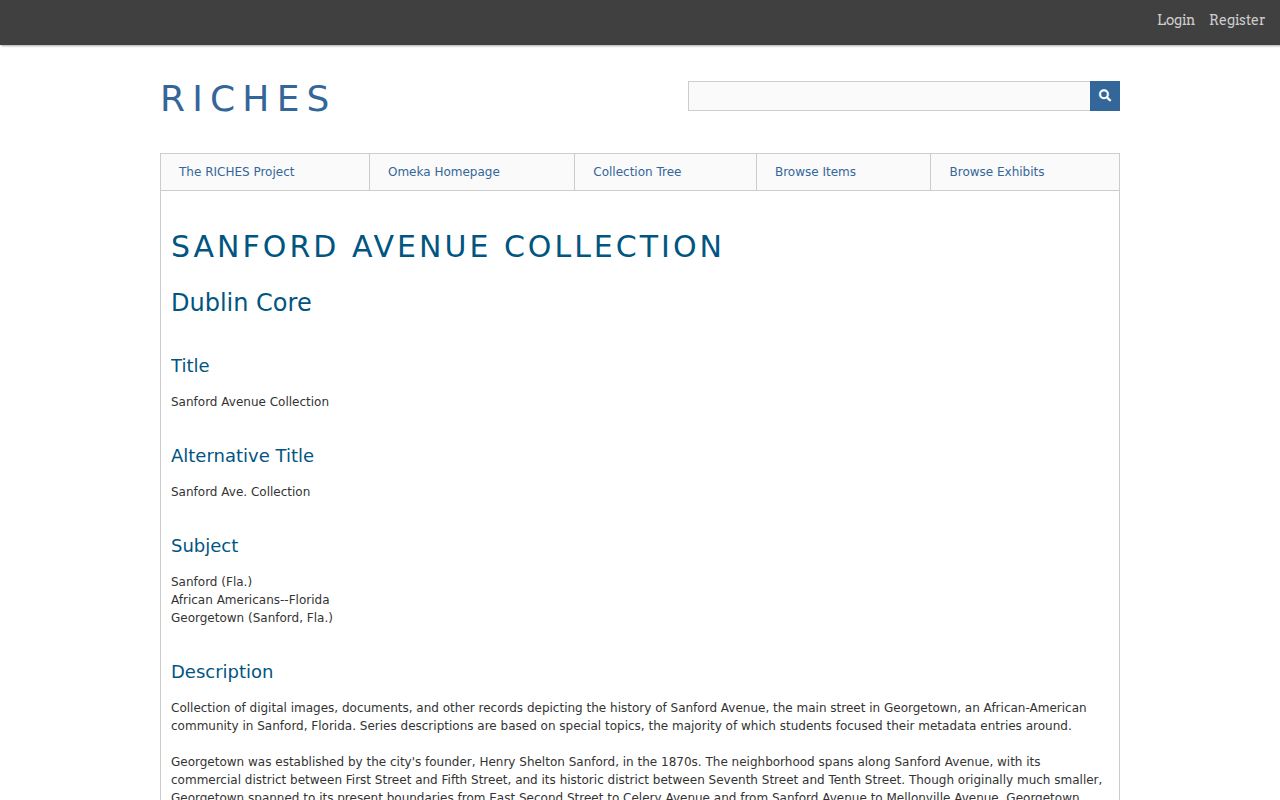
The collection capture confirms the local historical source. Cite the specific item or directory year used in the final research notes, since the collection page alone does not prove who occupied one address.
Date Seminole Address Changes
The Seminole County Building Permit Inquiry can date construction, additions, and other work. Its Search By control reveals the available input fields, and the portal is normally offline nightly from 11:30 p.m. until 4:30 a.m. A permit may identify an owner or contractor associated with the work, but not every resident. Compare permit dates with deed filing dates and the building chronology on the appraisal card.
The manifest capture shows the county permit inquiry used for this step.
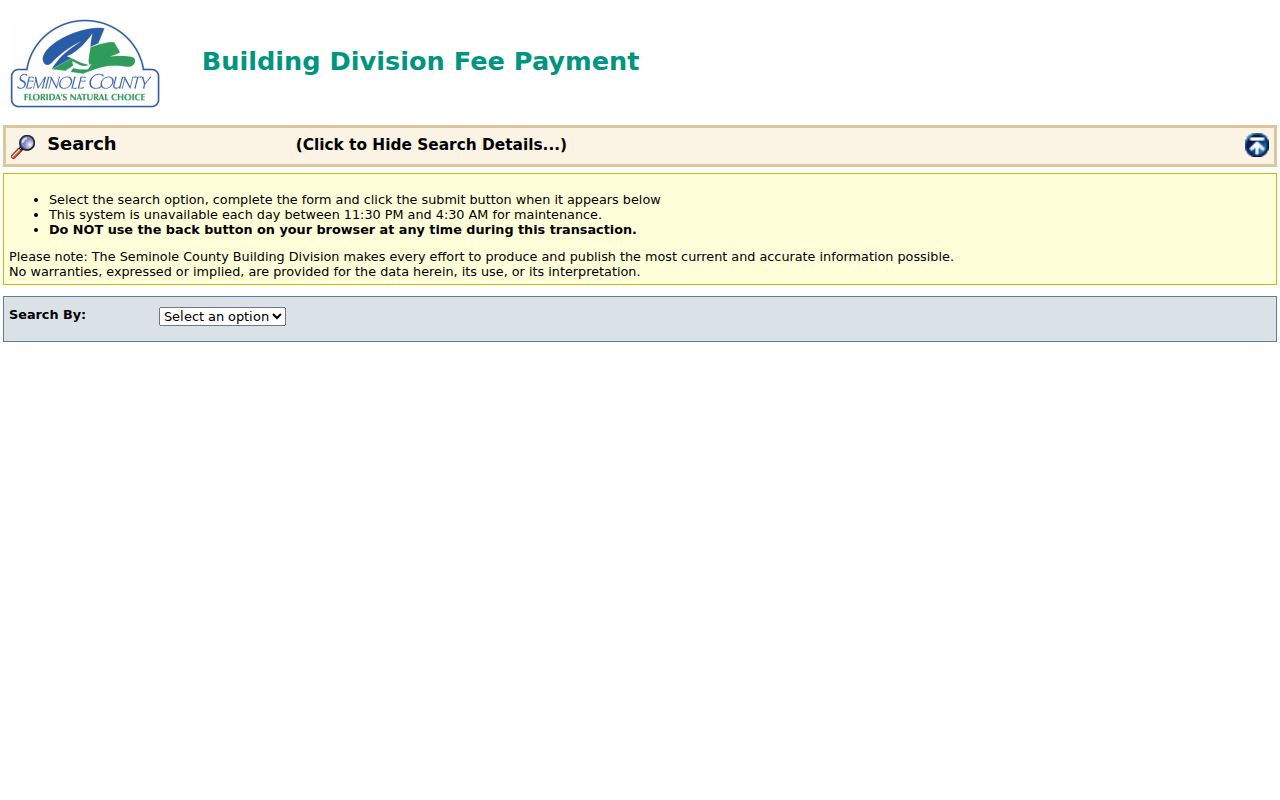
When a major permit follows a sale, it may explain a changed sketch, use, or value. It still does not prove that the buyer moved in on the filing date.
Close Seminole Previous Resident Trails
Probate and obituaries often resolve what happened after a name disappears from an address. The Seminole County Clerk keeps probate cases, wills, recorded death certificates, and related filings. An original will must be deposited within ten days after its custodian learns of the death. A recorded certified death certificate should omit cause. Search the decedent and likely heirs in probate, then compare dates and addresses with deeds.
The Seminole County Library offers HeritageHub, GenealogyBank, Ancestry, HeritageQuest, FamilySearch, Florida Memory, and Central Florida Memory. HeritageHub adds obituary and death-notice coverage dating from 1704 across its broader database. The Sanford Herald archive covers 1908–2005 and nearly 23,000 issues. More than 300 microfilm rolls were processed, with OCR taking almost two years. Poor early print means browsing a likely date can work when a name search fails.
The Museum of Seminole County History holds newspapers, assorted directories, family histories, and reference books at 300 Bush Boulevard. Call 407-665-2489 for a research appointment. Its marriage databases cover 1869–1910 and 1913–1983. These sources can link a past resident to relatives, a former community, or a later address without treating an obituary as a deed.
Search Orange County Before 1913
Seminole County was created from Orange County on April 25, 1913, with Sanford as the county seat. Earlier records may sit under Orange County even when the family and property stayed in place. For much earlier work, remember that Mosquito County was formed in 1824 and renamed Orange County in 1845. Search each jurisdiction in sequence rather than assuming a move.
Sanford also grew from Mellonville and later river, rail, citrus, and celery development. Goldsboro, Georgetown, Oviedo, Geneva, Chuluota, Longwood, and other communities may be better search terms than the modern postal city. The Great Fire of 1887, yellow fever in 1888, and freezes in 1894–95 help explain local turnover, but no authoritative source establishes that Seminole courthouse volumes burned. Do not invent a record loss.
Limits on Seminole Previous Residents
Owners are only half the story. A deed does not list every person who lived at the address, and a directory can omit many people. Census schedules are snapshots, not continuous residence logs. Permit holders may be owners, agents, or contractors. A sound account labels each name by the source that supports it and avoids turning an inference into a fact.
Florida also protects driver information, some voter fields, and addresses covered by exemptions or Safe at Home. A missing modern name may reflect a legal safeguard. Use old records for house history, family research, estate work, and personal curiosity while respecting living people and protected addresses.
Lawful use. Research Seminole County previous residents for a lawful purpose. Never use an address trail to stalk, harass, intimidate, or harm a living person.