
Seminole County Directory Years
Sanford is the center of the verified Seminole County city directory collection. The surviving trail is not one unbroken shelf. UCF identifies a 1915–16 Sanford volume and provides the complete 1917–18 R.L. Polk book online. The RICHES Sanford Avenue Collection cites added source years, while the Museum of Seminole County History holds assorted directories, reference books, family histories, and newspapers. Access shifts by year. One volume may be readable online, another may be known only through a collection citation, and another may require a museum appointment.
| Collection | Years | Where held | Access |
|---|---|---|---|
| Sanford City Directory | 1915–16 | Sanford Museum/UCF | Digital catalog |
| R.L. Polk Sanford directory | 1917–18 | Sanford Museum/UCF | Free digital volume |
| RICHES directory sources | 1911, 1917–18, 1924, 1926, 1947, 1952, 1965, 1975 | Sanford Avenue Collection | Citations; full-volume status varies |
| Sanford Herald | 1908–2005 | RICHES | Free search/browse |
| Federal census | 1790–1950 public | NARA/library tools | Online or branch |
The cited years do not prove every full volume survives or opens online. Ask the holder about the exact year and format before traveling. For years between volumes, newspapers, census schedules, marriage databases, deeds, and obituaries keep a household trail moving. Seminole County did not exist before 1913, so the same person may appear in Orange County records, and much older research may require the Mosquito County name.
Inside Sanford's City Directory
The digitized 1917–18 R.L. Polk volume is far more than an alphabetical name list. Its 228 pages cover Sanford, Altamonte Springs, Chuluota, Geneva, Lake Mary, Longwood, Monroe, Oviedo, Paola, and Wagner. A street section begins on page 23. Alphabetical names and the abbreviation key appear around page 43. Classified businesses begin on page 123. Civic pages identify government officials, churches, schools, clubs, labor groups, libraries, the post office, and secret societies. Those parts can link a name to a local institution when the household line is short.
The book also preserves the bias of its era. It uses an asterisk as a racial marker for Black residents. That was a discriminatory publishing practice, not a neutral modern category. Read it critically and search the dedicated Georgetown and Goldsboro collections so Sanford's Black communities are not reduced to the publisher's mark. Historical evidence is most useful when its limits remain visible.
The UCF catalog below opens the digitized book.
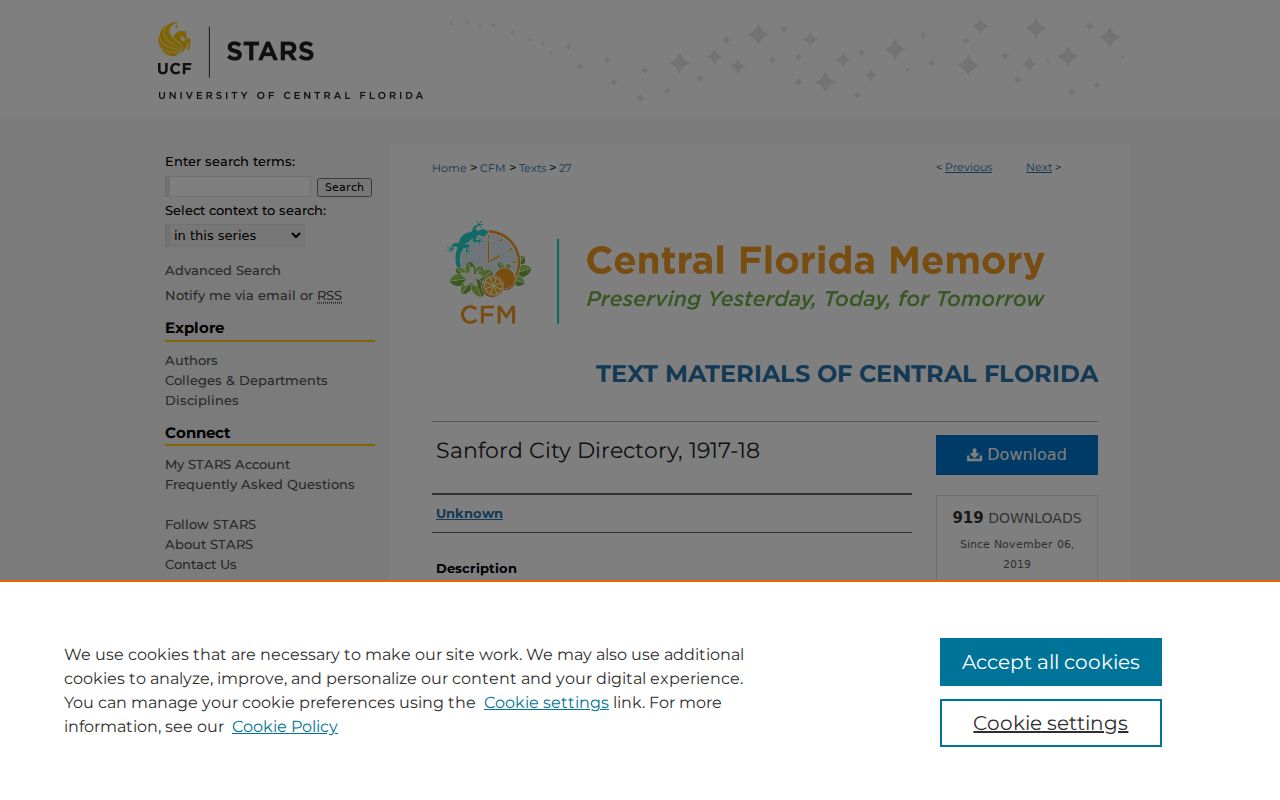
The scan lets readers move between name, street, business, and civic sections without relying on a modern index.
Decode Seminole County Directory Entries
Start with the book's own key. Codes differ by publisher and year, so a remembered abbreviation from another volume may mislead. A city directory entry may give initials, a surname, a short work or group code, and a residence address. The research did not verify a full sample line with spouse and owner or renter punctuation. Do not assume those fields appear in every Sanford entry.
| Name | Test full names, initials, spelling variants, and married surnames. |
|---|---|
| Work or group | Use the classified and civic sections to decode a short form. |
| Residence | Check the house number in the street-order section. |
| Nearby names | Repeated surnames suggest a lead, not proven kinship. |
- Criss-cross directory
- A list arranged by street and house number instead of surname.
- Householder index
- A street-order index naming the person tied to each listed address.
- Abbreviation key
- The volume's own list of codes, shortened words, and marks.
After finding a name, compare the street entry and inspect nearby households. This can separate two same-name people and show the block. It cannot prove that everyone in a home was listed.
Seminole County Archive Desks
The Seminole County Library research collection includes HeritageHub obituaries and death notices from 1704 forward, GenealogyBank, HeritageQuest, FamilySearch, Florida Memory, Central Florida Memory, and Ancestry Library Edition. Ancestry must be used in a branch. Jean Rhein Central is at 215 N Oxford Road in Casselberry, 407-665-1500. North Branch, useful for Sanford work, is at 150 N Palmetto Avenue, 407-665-1620. Typical hours are Monday through Thursday 9 a.m. to 8 p.m., Friday and Saturday 9 a.m. to 5 p.m., and Sunday 1 to 5 p.m.
The Museum of Seminole County History, 300 Bush Boulevard, holds newspapers, directories, maps, books, and family histories. Call 407-665-2489 for a research appointment. Sanford Museum at 520 East First Street is the repository UCF names for the Polk volume; its number is 407-688-5198. Direct contact matters because no full museum shelf inventory is published online.
The library page below is the branch research entry point.

Check which database needs a card or in-branch session before planning the search.
Fill Seminole Directory Gaps
The free Sanford Herald archive holds almost 23,000 issues from 1908 through 2005. More than 300 microfilm rolls were processed, and optical character recognition took nearly two years. Yet early print can search poorly. If a surname fails, browse the likely date range and try initials, married names, addresses, churches, clubs, schools, and business names.
The county museum has newspaper microfilm from August 1908 forward and marriage databases split into 1869–1910 and 1913–1983. That break follows county formation. A person did not need to move for the county label to change. Sanford belonged to Orange County before Seminole County was formed on April 25, 1913. Records before the 1845 rename may use Mosquito County.
The image shows the newspaper archive's search and browse interface.
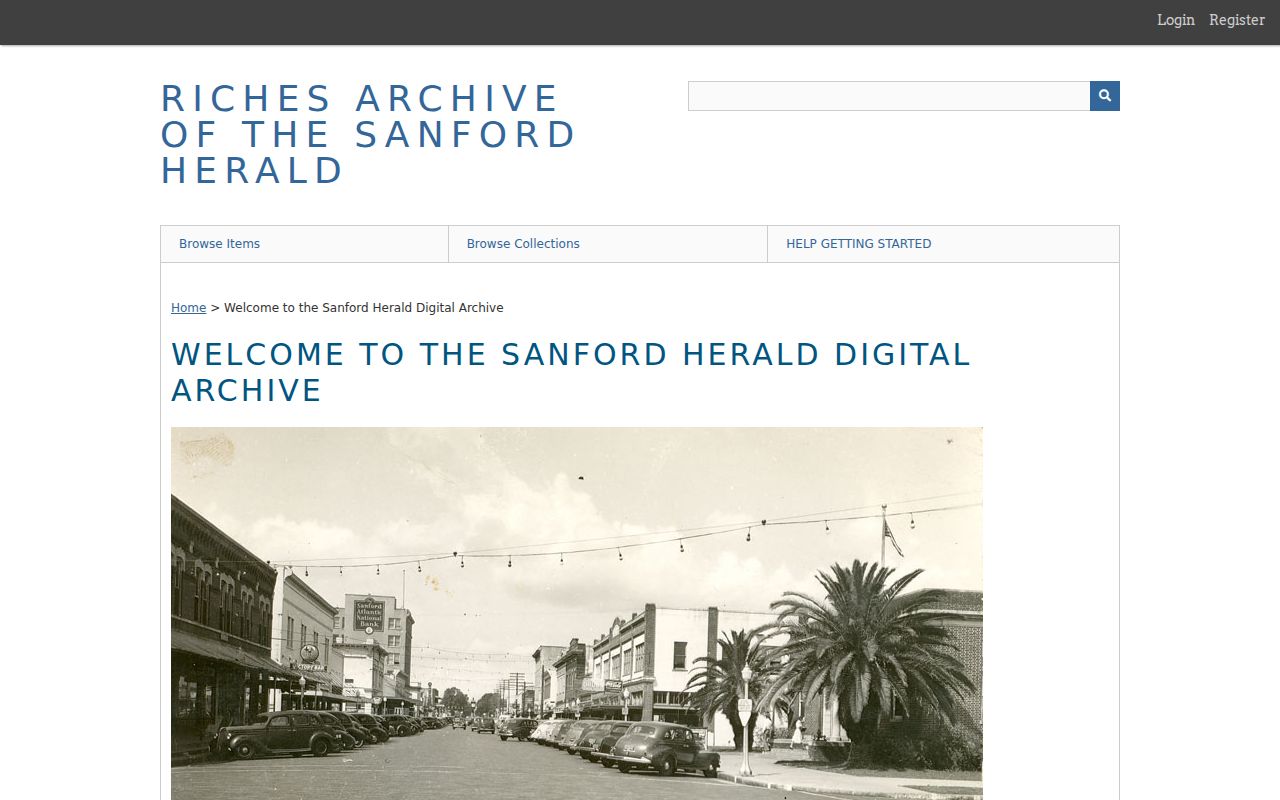
Date browsing often works better when faded type defeats text search.
Note: Search Orange County for events before 1913 before deciding that a Seminole household vanished from the record.
Search Seminole's Directory Communities
The Polk directory extends beyond modern Sanford. Search its Altamonte Springs, Chuluota, Geneva, Lake Mary, Longwood, Monroe, Oviedo, Paola, and Wagner sections when family notes use those names. RICHES also holds collections for Georgetown, Goldsboro, churches, Naval Air Station Sanford, baseball, cigar making, riverfront life, markets, and schools. A community or institution term can identify a person when direct name search fails.
Do not project today's mailing cities backward. Historical communities do not always match city lines or postal labels. Sanford and Mellonville carry river, rail, citrus, and celery history. Oviedo, Geneva, and Chuluota have rural and farm trails. Lake Mary and Heathrow reflect later planned growth. Search the place name used in the record's period.
Trace Seminole County Families
A Seminole County city directory works best in a linked search. Begin with the nearest known year, then compare the same name and address in each available volume. The street section confirms the block. Census schedules add household members. Deeds, probate, obituaries, and newspapers help split same-name residents. Absence proves little because women, boarders, rural families, and people who declined a listing may be missing.
- Find the surname in the alphabetical section, testing initials and spelling variants.
- Read the key, then record the address and each work or civic clue.
- Check the street section and nearby names for context.
- Pair 1917–18 with the 1920 census, and compare 1947 or 1952 with 1940 and 1950.
- Use deeds, probate, marriage files, obituaries, or newspapers to explain a move or disappearance.
Keep the volume, page, exact printed name, and address in the citation. Save the key page too. A later reader must know whether a code came from the publisher or an interpretation. For current address research, the Seminole County street directory covers the property and GIS path.
Seminole County Directory Timeline
Jurisdiction and format changes explain many apparent gaps. Use the event date, not today's county label, to choose the first catalog.
| Year | Research effect |
|---|---|
| 1845 | Mosquito County became Orange County. |
| 1908 | Sanford newspaper microfilm and the later digital archive begin. |
| 1913 | Seminole County formed from Orange County. |
| 1917–18 | The Polk volume documents ten communities. |
| 1950 | The newest public federal census adds household context. |
| 2005 | The digital Sanford Herald range ends. |
The Great Fire of 1887, yellow fever in 1888, and the 1894–95 freezes help explain turnover. No authoritative research source says courthouse volumes burned, so these events should not be used to claim record loss.
A timeline also guards against a common catalog error. A modern place name may be a useful keyword, but it should not replace the jurisdiction printed on the original item. Record both forms in the research notes. Search the older county name, the historic community, and the modern city in separate passes. This is useful for families who stayed near Sanford while borders and local labels changed around them. It also makes a negative search easier to audit because another reader can see which names, years, and repositories were checked.